From corner offices in New York to conference rooms in Silicon Valley, business leaders are grappling with the same question: how will AI reshape our businesses?
For some, AI is elevated as a cure-all, justified by the promise of “efficiency” – a sanitized euphemism for surrendering agency, stepping aside, and allowing an algorithm to quietly replace critical thought and human intention. But hey, should juicier bottom lines and cheerful shareholders on an earnings call be the goal, there are certainly CEOs licking their chops at both – even if it comes at the cost of thousands of pink slips, signed by an algorithm and justified by a spreadsheet.
That is certainly one way of looking at things. But an enduring power of sports is this: No matter the economic or geopolitical climate, it still largely remains AI-proof, tariff-proof, and recession-proof. We are nowhere near an era of AI-generated athletes or synthetic talking heads replacing the real thing – at least, not yet. But until we get there, like it or not, AI is here to stay. And as sports leagues and tech companies converge to consider how data and analytics can reshape their businesses and enhance their products, the first question can not be about margins or revenue targets. It must be: How will this impact the fans?
“At Amazon Web Services, we work backwards from the customer,” said Julie Neenan Souza, Global Head of Sports at AWS, describing the company’s famous approach of designing products around the ideal customer experience rather than building first and hoping customers follow.
“I’m not interested in creating or suggesting anything that doesn’t add value for the fan. It’s always about identifying the problems the fan faces and finding ways to solve them.”
According to IBM, a study of over 20,000 sports fans across 12 countries shows growing enthusiasm for technology – especially AI – in sports. Since 2024, AI usage has increased, with 85 per cent seeing value in it and 63 per cent trusting AI-generated content. Fans prioritize real-time updates and personalized experiences. Only 27 per cent expect their habits to stay the same, while 80 per cent believe AI will most influence sports consumption by 2027, with 56 per cent seeking AI-powered insights and commentary.
Sports consumption is changing rapidly, and the fast-growing world of technology is calling the plays. Using Amazon’s working backward approach, it is clear that if fans want it, the leagues need to deliver the right moves.
“It’s all about fan choice. Historically, we delivered games one-to-many through linear broadcasts,” said Ken DeGennaro, National Basketball Association Executive Vice President and Head of Media Operations and Technology, when discussing how fan viewing habits have shifted.
“As fans now engage with different features, we learn and personalize the experience, and the ‘lean-back’ experience adapts to what fans want, helping us better understand and respond to fan behaviour.”
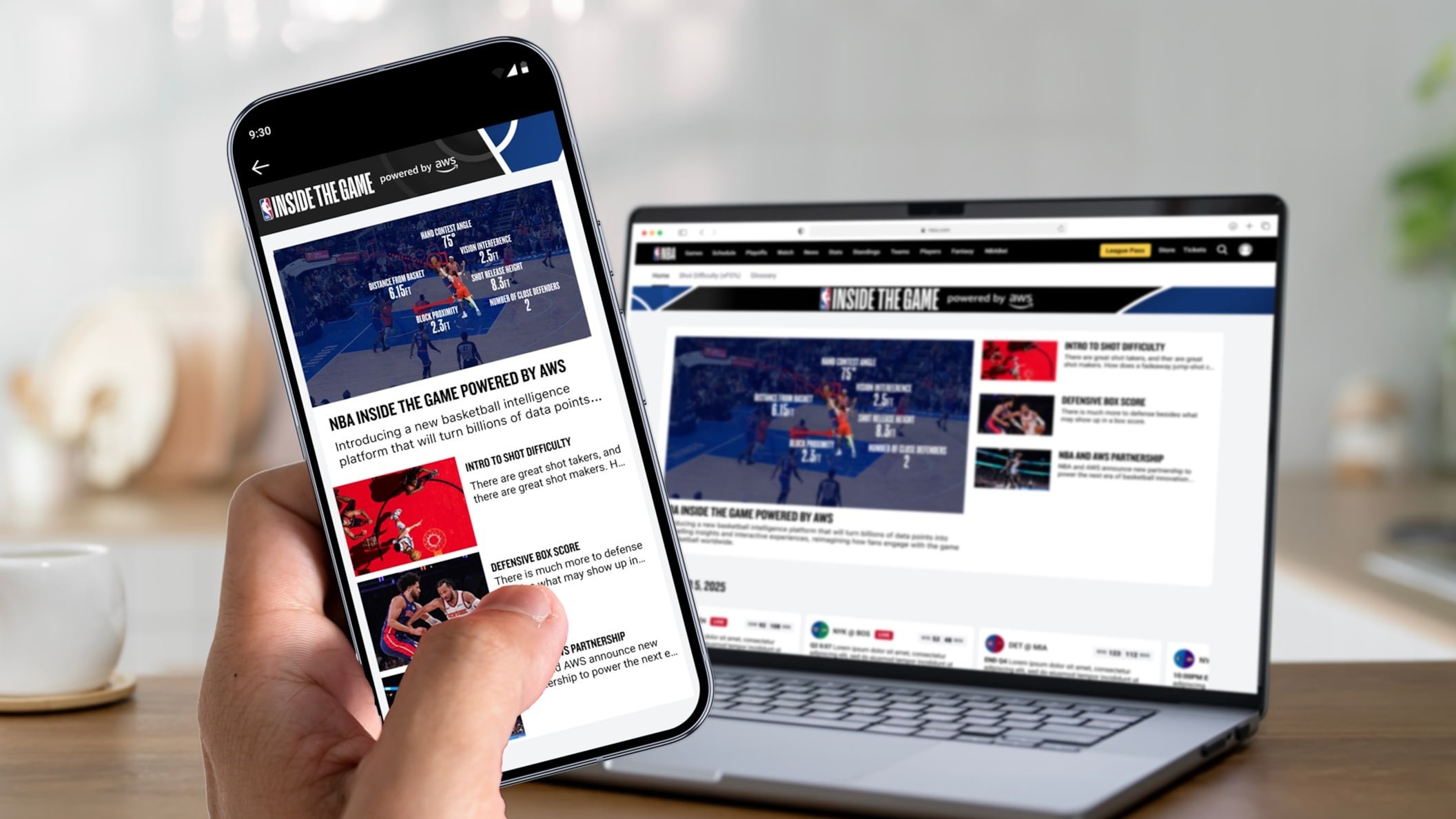
Take Amazon’s customer-first mindset, view it through the NBA lens, and you get NBA Inside the Game powered by AWS. Announced in October ahead of the current NBA season, this partnership is now redefining how basketball fans around the world watch and engage with every game.
By embedding AWS’s AI across its technology stack to create a basketball intelligence platform, the NBA can transform vast amounts of data into interactive fan experiences and real-time insights delivered during live games, most notably through on-screen stats and comprehensive analytics.
Instead of watching a game while repeatedly reaching for your phone to check a box score, the numbers on your TV come to life instantaneously, revealing insights that go far beyond traditional statistics and would be impossible to surface without AWS’s cutting-edge algorithmic technology.
This analytics platform uses AI and machine learning to process the NBA’s player-tracking data, which tracks 29 data points per player to generate real-time insights that help fans understand the game in new ways. It tracks performance metrics that have never been measured before, such as Defensive Box Score, Shot Difficulty, and Gravity, to name a few. AWS’s Play Finder takes this further, analyzing thousands of games using AI to instantly find past plays, see patterns in team strategies, and combine play results with advanced analytics.
During a National Football League broadcast, you might hear commentators say, “analytics say go for it” on a fourth down. The idea is similar here – models ingest massive amounts of data and identify whether comparable plays in the past were successful, giving fans context and a unique way to follow the action.
“Sometimes people say the raw data of sports used to be a box score. Something you could look at and make sense of. Now, the raw data in sports are x’s, y’s, and z’s on the court, field, or ice. You’re talking about massive volumes of data that humans with clipboards and Excel can’t practically analyze. This is a job for machine learning and AI,” said Souza.
DeGennaro played a key role in the successful 2013 launch of NBA.com/stats and has a deep understanding of how far sports analytics have evolved.
“When we launched [NBA.com/stats], we moved from text files to data warehouses with compute models. Tracking data and machine learning now allow real-time, nuanced analysis, capturing not just outcomes but context – who defended, play setups, and even predictive insights, providing far more descriptive, advanced statistics than post-game analysis allowed in 2013.”
Souza and DeGennaro see personalized fan experiences as always evolving, focused on understanding what viewers want. Whether it’s ordering snacks before halftime, comparing fantasy stats with friends, or adjusting the broadcast for a younger demographic, it’s about letting fans “choose their own adventure,” as Souza put it.
One concern the NBA community has raised in recent years is that analytics have made the viewing experience feel overwhelmingly data-heavy. Yet as much as AI and machine learning are transforming how fans watch the game, they’re equally reshaping how the game is actually played.
By telling defending teams which shots are “safe” to give up and guiding offensive teams on how to maximize points per possession, data analytics and machine learning (not Steph Curry!) have fueled the three-point revolution, turning the NBA into a league where shots behind the arc dominate offensive schemes. And if AI can make better decisions faster, why do we even need coaches yelling from the sidelines when algorithms can call the next play?
“Data is a tool to be applied at particular times,” said DeGennaro. “The best coaches are the ones who use data in the right situations to gain maximum efficiency from their team. They can’t rely on it solely. They know their players, the moment, and the context. But their decisions still need to be informed by data, or they’re at a large disadvantage.”
“Coaches and players can use it as a tool to advance their understanding and strategy. But there will always, and should always, be a non-quantitative part of the sport, because that’s equally important,” said Souza.
So what happens when a coach is torn between gut instinct and the data? In the dying seconds of a game, which do you trust?
“If a player says, ‘give me the damn ball,’ and the coach allows them to take the shot, that’s complemented with data – what plays has this player been successful with, and what sets can we run against a particular team or defence to maximize their opportunity? That’s where the two come together. The feel of the play by the coach, helped and informed by analytics,” DeGennaro said.
It’s difficult to predict where AI will take things next. What’s clear, however, is that its future in sports won’t be decided in boardrooms or engineering labs. Ultimately, it will be up to the fans. Whether AI enhances the game or overwhelms it will depend not on the technology itself, but on what viewers choose to embrace, and what they don’t.
Follow Aleksa on Instagram and X: @aleksa_cosovic

